
IN HIS OWN WORDS
In issue 83 of Al-Kawthar magazine (2006), Dr. Abdul Rahman Al-Sumait recounted his journey to Namakia in north-western Madagascar, home to a queen of Arab descent named Amina Said. He had tried to reach her for years, and once a storm at sea turned him back. When he finally got there, by ferry and in a truck that sank into the mud twice, what he found waiting for him was harder than the road.
While I was in Madagascar, I tried for a long time to visit the queen of Arab descent, Amina Said, but every attempt came to nothing because there was no suitable transport. The usual way is to cross the sea by ferry, then ride an old truck on a journey that can take 12 hours, then change to another vehicle to Namakia, where the queen lives. Reaching her can sometimes take more than 24 hours.
I remember that years ago I decided to go to her in a fast motorboat owned by a Frenchman living in Madagascar. He asked for a large sum, and I had to agree because there was no alternative. But we were caught by a storm and high waves, and the pilot told us the fuel was running out, that we could not reach Namakia, and that the storm was coming. So we took refuge on an uninhabited island with Islamic ruins (a mosque, houses, and many graves built facing the qibla). The Portuguese had attacked it, burned it, killed its men and assaulted their women, then thrown them into the sea; as for the children, they amused themselves by throwing them into the sea as food for the sharks.
After that we had to visit a neighbouring island where more than 96% of the inhabitants are Muslims, yet its young men and women know nothing about Islam. They implored us to build them a mosque and send them a preacher, because the only person there who can recite al-Fatiha does so brokenly. We built the mosque, but it remained without a preacher.
We came back from that island without reaching our goal, but at least we had discovered it, and we returned to the city of Mahajanga.
This time, we decided to risk the ferry across the sea to the peninsula. After an hour we reached the village of Mitsinjo, but the ferry stopped twenty metres from the shore, and its crew asked us to drive down into the sea in our pickup truck, which cannot swim. After some haggling with a few young men, we paid them 450 fils (5 Saudi riyals), and they brought strong planks and laid them between the ferry and the shore so our truck could cross.
Muslims… but…
As we entered the village, a man came to us claiming to be an envoy of the mayor, inviting us to visit him at his office. We accepted, and our host welcomed us warmly and said he was a Muslim named Hasan. The village, he said, had once been Muslim, and its elders still pray in the mosque, but the young men and women know nothing about Islam. Then he pointed to the wall, where the village emblem was painted with the words “Religion and World”, and said: “We love Islam, but we are ignorant. Some time ago a Qadiani delegation visited us and asked for land to build a school for our children. We welcomed them and registered the land in their name, but they never came back. We implore you not to leave us alone with Satan; here are our children, with no teacher to teach them the basics of their religion.”
We left Mitsinjo after visiting the mosque, which was clean and tidy, but we saw no young people in it, only the elderly.
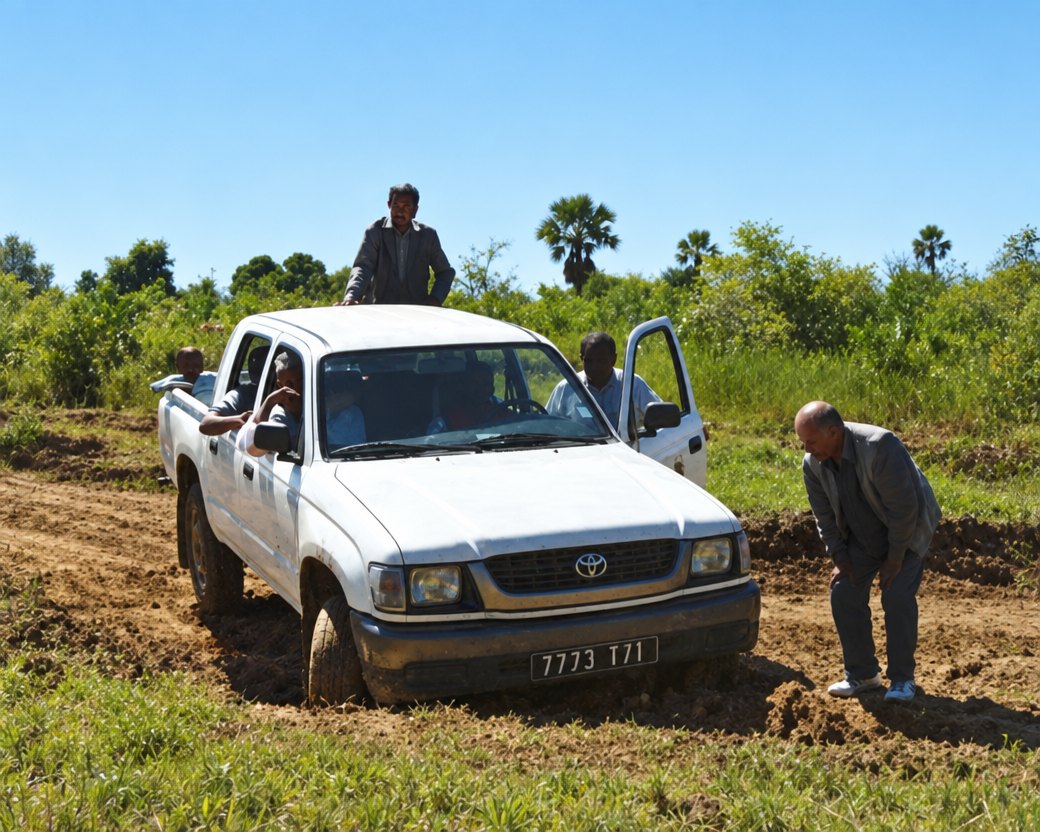
On the road, the truck sank into the mud
We drove on in our four-wheel drive knowing it was a risk, because the road was bad. After crossing several fords, the wheels sank into one of them, all mud, and every attempt we made came to nothing. After two hours a lorry arrived and pulled the truck out with an iron chain, but to our shared misfortune the lorry fell into the same trouble, and we stayed together for two hours trying to do something, until God granted us its release from the mud.
After hours on a dirt road, we reached a huge sugar factory, but it had stopped working completely. Next to it was a factory producing alcohol, employing “Muslim workers” who do not know that alcohol is forbidden. (…) We passed through about eight villages and found no preacher in any of them, even though most of their inhabitants are Muslims (all of them were Muslims in the past). What we saw of the condition of the Muslims in this region pains the soul and makes the heart weep… ignorance of the most basic principles of Islam… deviations in belief and in law… every village here needs a school, a preacher and a teacher.
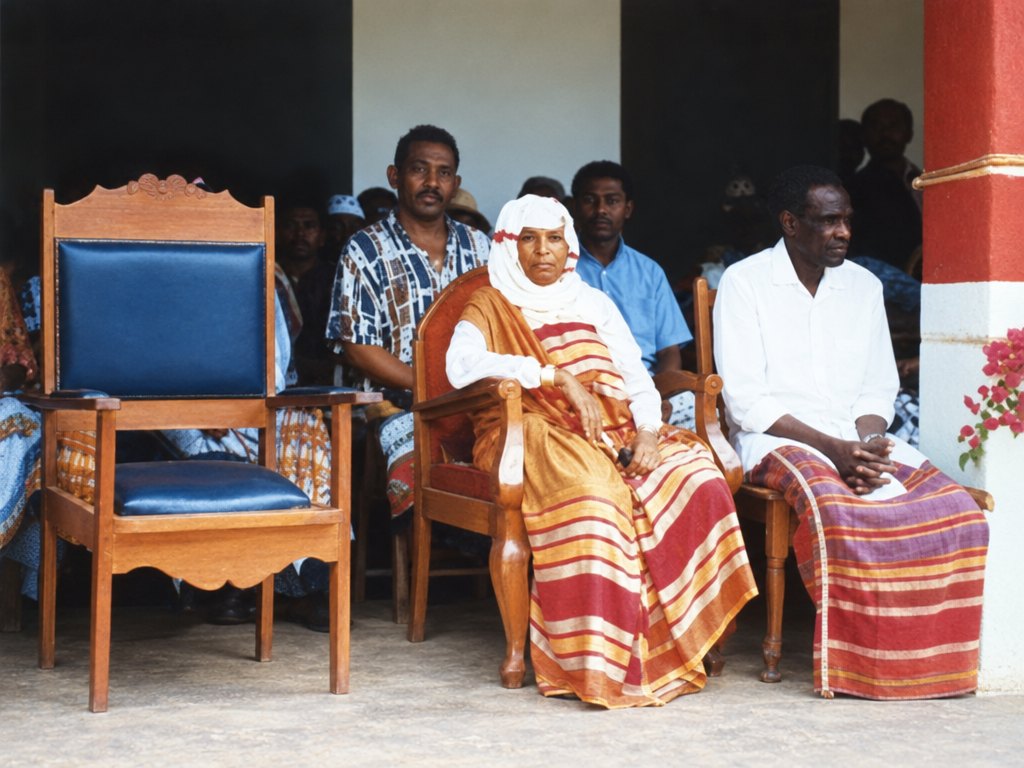
They pray six days a week in the mosque… and worship the queen on Saturday
A queen who knows nothing of Islam
The Queen’s House
We reached the village of Namakia with difficulty, as I mentioned, and headed to the house of the region’s queen, Amina Said. Her husband received us and asked us to wait outside while she prepared to receive us. We stood in the street between the queen’s house and the huge Protestant church, waiting, and after half an hour her husband came to tell us that she was ready for us.
We found her about fifty years old, smiling, her skin close in colour to that of Arabs, although the people of the region are all closer in complexion to Africans. She welcomed us, and we sat with her in the presence of her husband. I told them that we were from Kuwait, from the land of Makkah, and that my people had sent me to ask after Queen Amina and the state of her land and people. Then I asked her whether she knew where her name came from. She said no, so I told her: Amina was the mother of the Messenger, peace and blessings be upon him and his family, and Said was one of the ten Companions promised Paradise.
I gave her a woman’s dress I had bought in Mahajanga, and explained to her the pillars of Islam; between one pillar and the next I presented her with a gift from her brothers in Kuwait and Makkah. I asked whether she would be ready to perform Hajj this year with her husband if we helped them fulfil this duty with the money of a benefactor, and she said she was. I pray to God to make her Hajj the beginning of change in the whole region.
The situation I saw was extremely painful, because the Muslims pray in the mosque six days a week and worship Queen Amina Said on Saturday, while she knows nothing about Islam. I gave her some booklets on the principles of Islam; I ask God to guide her, and to guide others through her.
On the way back our truck sank into the mud again. After four hours of trying, the brothers listened to my suggestion that we stop and pray Maghrib and Isha, combined and shortened. It was then ten o’clock at night. After the prayer, which we prayed on the mud, we pushed the truck and God blessed us with its release. We slept that night on the beach, with no hotel, no restaurant and no place to rest, and the cold was bitter. Early in the morning the ferry came to take us back to Mahajanga.
SOURCE
Al-Kawthar magazine, issue 83, 2006.
Translated from the Arabic for this site; ellipses mark abridgements in the source.
Read next: The Vessel They Kept, Waiting for Islam →